

HMRC VAT software vs accounting software: The smarter choice for UK businesses
- No credit card required
Talk to our VAT experts
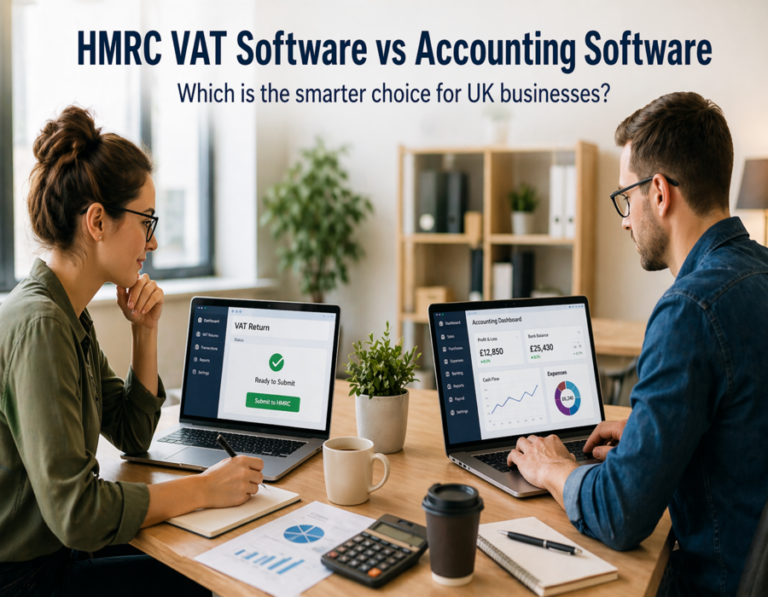
HMRC VAT software is built for one job. It handles VAT submissions in line with Making Tax Digital rules.
Key functions include
- Direct submission of VAT returns to HMRC
- Digital record keeping for compliance
- Error checks before submission
- Bridging data from spreadsheets or systems
This type of software prioritises compliance. It ensures your VAT returns meet HMRC requirements without manual work.
What is accounting software in the UK?
Accounting software manages your full financial activity.
It typically includes
- Invoicing and billing
- Expense tracking
- Profit and loss reporting
- Payroll and cash flow
Some accounting platforms include VAT features. However, not all are fully optimised for HMRC submission workflows or compliance checks.
Difference between VAT software and accounting software in the UK
- The difference comes down to purpose.
- HMRC VAT software is compliance-focused
- Accounting software is finance management-focused
- Here is how they compare in real use
Compliance
- VAT software is designed to comply exactly with HMRC rules.
- Accounting software may support VAT, but not always with all the features needed to follow the rules.
Complexity
- VAT software is simple and task-specific
- Accounting tools are broader and more complex
Risk level
- VAT software reduces submission errors
- Accounting tools depend on setup and user input
Use case
- VAT software suits businesses that only need filing
- Accounting software suits businesses managing full finances
HMRC VAT software vs accounting software for small businesses in the UK
Small businesses often rely solely on accounting software. This works in some cases but not always.
Accounting software might be enough for your business if your transactions are simple. But problems come up as things get more complicated.
- Some common problems are
- Wrong calculations of VAT
- Links that are missing
- Changes made by hand before submission
VAT software removes these risks by focusing only on accurate submission.
For small businesses, the decision often depends on time and risk tolerance rather than cost.
Do you need HMRC VAT or accounting software?
You need to match the tool with your workflow.
Choose VAT software if
- You already use spreadsheets
- You want fast and simple VAT filing
- You only need compliance
Choose accounting software if
- You deal with bills and expenses every day.
- You need complete financial reports.
- You want a system that does everything.
Many businesses use both tools simultaneously. Accounting software keeps track of data. The VAT software handles the submission.
HMRC-compatible accounting software vs VAT software
Not all accounting software is fully HMRC compatible in practice.
Some tools claim compatibility but still require
- Manual adjustments
- Add-ons for submission
- Extra steps for compliance
VAT software is built around HMRC systems from the start. That makes the process smoother and more reliable.
This is where many businesses shift from accounting-only tools to dedicated VAT solutions.
Is accounting software enough for VAT returns in the UK?
In theory, yes. In practice, not always.
Accounting software can submit VAT returns if
- It supports MTD fully
- It is configured correctly
- Data is accurate
But errors often happen due to
- Incorrect VAT codes
- Misclassified expenses
- Manual overrides
VAT software adds a layer of control. It validates data before submission, reducing risk.
Cost comparison of VAT software vs accounting software
People often get costs wrong.
Accounting software usually costs more each month because it offers many features.
Businesses that only need to file VAT software are often less expensive and more focused.
- Time spent fixing errors
- Risk of penalties
- Complexity of workflows
A cheaper tool that causes errors can end up costing more in the long run.
Which option saves more time and money
For most UK businesses, the smarter choice depends on scale.
If your business is simple
- VAT software saves time
- Less setup
- Faster submissions
- Lower learning curve
If your business is growing
- Accounting software becomes useful
- Better reporting
- Centralised financial control
If your business is scaling
Using both tools together is often the most efficient setup
This hybrid approach reduces risk while keeping operations smooth.
Common mistakes UK businesses make
Many businesses assume one tool can do everything.
This leads to
- Overcomplicated accounting setups
- Missed VAT compliance steps
- Delayed submissions
The smarter approach is to separate tasks
Use accounting software for management
Use VAT software for compliance
This reduces errors and improves efficiency.
Final thoughts
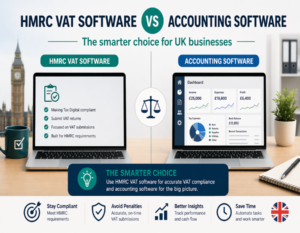
HMRC VAT software vs accounting software is not about choosing one over the other. It is about using the right tool for the right job.
If your priority is compliance and speed, VAT software is the better option.
If your priority is full financial control, accounting software is essential.
For many UK businesses, combining both delivers the best result. It reduces risk, saves time, and ensures accurate VAT submissions.
Disclaimer: Our blogs and articles are written to share general information only. If you’re looking for an easy way to submit your VAT under Making Tax Digital (MTD), SwiftVATPro offers a simple and reliable online solution.
Frequently Asked Questions:
Your Questions – Answered ,We’re here to help you with anything VAT-related.
1. Can HMRC VAT software work without accounting software?
Yes, it can. HMRC VAT software is designed mainly for VAT submission and compliance, so it does not need full accounting software to function. Many small businesses and freelancers use VAT software alongside spreadsheets to manage their records.
This setup works well if your transactions are simple and you do not need detailed financial reporting. However, as your business grows, relying only on VAT software can feel limiting. You may need better visibility into profits, expenses, and cash flow. That is where accounting software becomes useful.
In simple terms, VAT software can handle compliance on its own, but it does not replace full financial management. If your goal is just to submit VAT returns correctly, it is enough. If you want deeper insights into your business performance, you will likely need accounting software.
2. Why do some businesses use both VAT and accounting software?
Many UK businesses use both because each tool serves a different purpose. Accounting software helps manage day-to-day finances such as invoicing, expenses, and reporting. VAT software focuses on submitting accurate VAT returns to HMRC.
Using both together creates a smoother workflow. You manage your financial data in accounting software, then send clean and structured data to VAT software for submission. This reduces manual work and lowers the risk of errors.
Businesses with higher transaction volumes or more complex VAT rules often prefer this setup. It gives them control over finances while ensuring compliance is handled properly. While it may seem like an extra step, combining both tools often saves time in the long run. It also reduces the chances of mistakes that could lead to penalties or corrections later.
3. What are the risks of using only accounting software for VAT?
Using only accounting software for VAT can work, but it comes with risks if the system is not set up correctly. Many errors happen because VAT codes are applied incorrectly or transactions are misclassified. These small issues can affect the accuracy of your VAT return.
Another risk is missing compliance requirements, such as digital links or proper record keeping, under Making Tax Digital rules. Not all accounting tools guide users clearly through these steps. Manual adjustments are another common problem.
When businesses edit figures before submission, it increases the chance of mistakes. Over time, these errors can lead to penalties or HMRC enquiries. VAT software reduces these risks by validating data before submission. It acts as a safety layer, ensuring everything is accurate and compliant before it reaches HMRC.
4. Is VAT software easier to use than accounting software?
For most users, yes. VAT software is usually simpler because it focuses on a single task: VAT submission. The interface is often straightforward, with fewer features and less setup required. This makes it easier for non-accountants or small business owners to use.
Accounting software, on the other hand, includes many features such as invoicing, reporting, payroll, and expense tracking. While this is useful, it also makes the system more complex. It takes time to learn and configure properly.
If your main goal is to file VAT returns quickly and accurately, VAT software is often the easier option. But if you need to manage your entire financial workflow, accounting software becomes necessary despite the learning curve.
5. How do I decide which software is right for my business?
The best way to decide is to look at how your business operates day to day. If you mainly need to submit VAT returns and keep compliant records, VAT software is usually enough. It is simple and focused, reducing the risk of errors.
If you regularly send invoices, track expenses, and monitor profits, accounting software is a better fit. It gives you a complete view of your finances and helps you make decisions. You should also consider your business size and complexity.
Smaller businesses often start with VAT software and basic tools. As they grow, they move towards accounting systems or combine both solutions. Think about your priorities. If compliance and speed matter most, choose VAT software. If control and insights matter more, go with accounting software or a combination of both.